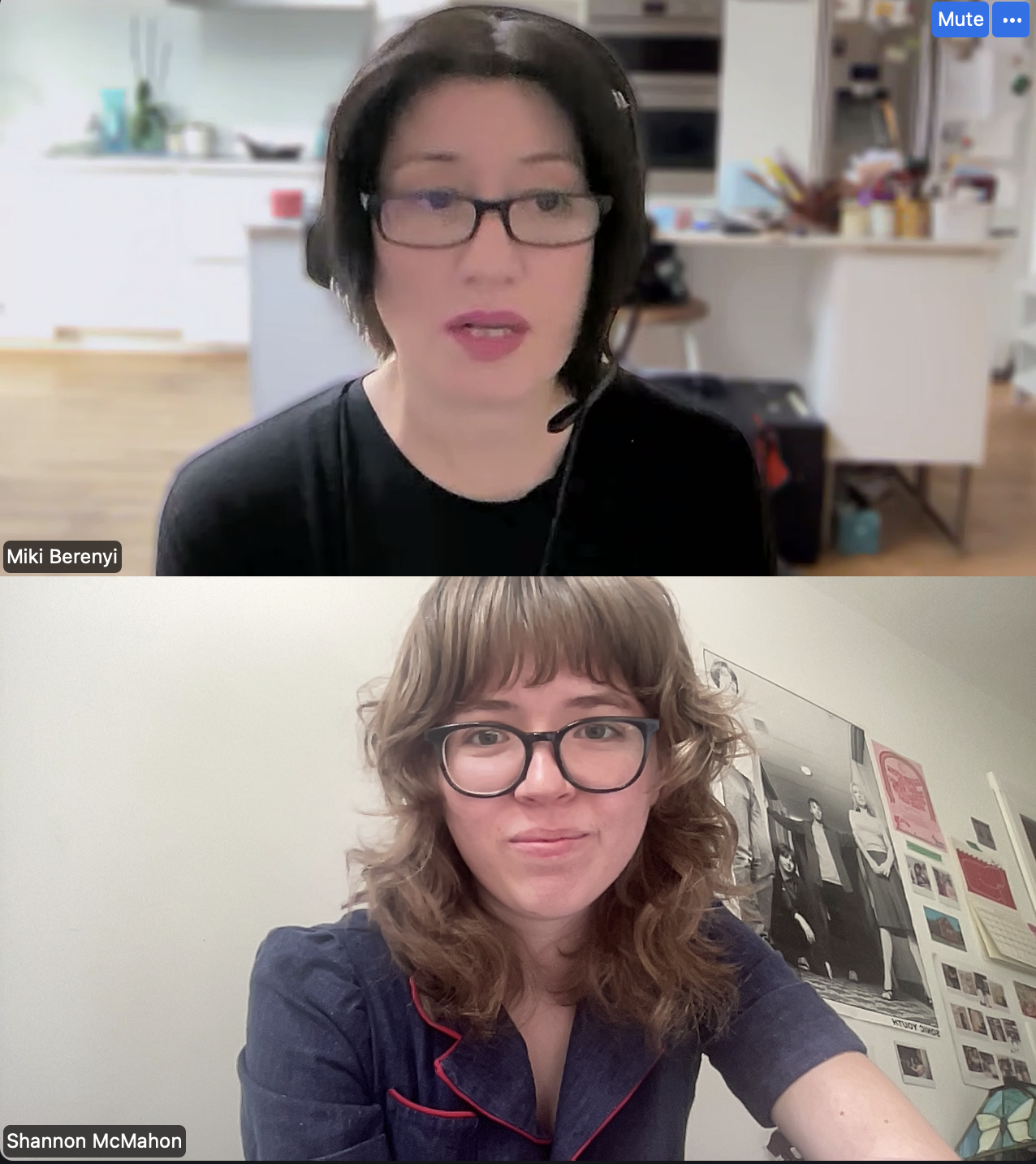
With your new project, MB3 (Miki Berenyi Trio), was there any sort of apprehension with returning to music after previous larger projects like Prioshka and Lush? Especially because you decided to go under your own name with this one–
There wasn't much apprehension because I think after Lush broke up the first time and I came back for the reunion, that's when all the apprehension was like, “is this really a good idea?” But then I think with Lush, just playing music again was really great. So that's why Prioshka happened. Then out of Piroshka, it was kind of because I'd done a book as well– that was during lockdown–so it felt quite organic. There wasn't much trepidation and maybe that's why there was very little pressure. It didn't feel like, “Oh my God, there's got to be this great unveiling and what are people going to say?” It's probably the most relaxed I've been, actually. The name was purely because when we decided to actually make it a going concern, it was actually Ollie and Moose who were like, “Well, we're just going to have to call it Miki Berenyi Trio, aren't we?” And I kind of got it because when we did Prioshka, it was like, “Oh, we'll come up with this clever name,” right? The world doesn't work that way anymore. Nobody knows it's you unless you stick your name front and center. But the irony is it's under my name and it is actually all three of us. It's probably the most equal band I've ever been in.
When you were making the album, Tripla, what was influencing the music itself? Were you taking in inspiration from outside sources or was it mostly self-referential?
Ollie is the kind of new element in the band because obviously Moose was in Piroshka. Ollie brings quite a lot of programming background and a lot of the songs, before we even thought of doing an album, we were just having fun. So right at the beginning, we just had a couple of songs that we were playing live within Lush songs, which was all to promote the book really. Then it just went on from there. But we didn't have a drummer. It was the only way we could afford to do it really. Then because we were then having to do backing tapes and stuff, working with Ollie made it really easy rather than my shit kind of drum machine. I think a lot of the sound came out of that, that being a kind of new element of the collaboration was having someone who does a lot of programming. Also Ollie writes songs. So “Vertigo,” which was the first thing we put out, was actually from a song of his and I just reworked it and I rewrote the lyrics and did some arrangements on it. But that's when we realized, “Oh, we actually work really well together.” It was quite exciting finding out how the three of us worked. There were little things too, like we went on tour with the Gang of Four and I remember writing that song, “Gango,” afterwards because I just liked snatching little elements of what they did. They had this song where I really liked the way these sort of disparate parts ended up coming together and I thought, “Oh, that's a good idea. I'll try something like that.” And that's how it came out. It doesn't sound anything like a fucking Gang of Four song, but you know, it's the idea.
I've seen you say that you've never been too comfortable with playing the guitar, but that you also only really use it to write songs… Do you remember the first encounter you had with the instrument and what drew you to the guitar in the first place?
I'm going to be honest, I think when I was a teenager, I went out with quite a few guitarists. So there was always one lying around. Also, when Emma first joined the band, she joined playing bass. She was playing bass in a band called The Bugs, so when we were thinking of doing stuff together, she was like, “well, I'm already playing the bass, so you have to play the guitar.” I wasn't particularly…if I'm totally honest, I just wanted to be in a band. I didn't really give a shit how I got in. I certainly didn't want to be a singer. So even being a singer in Lush was because our original singer left and we didn't have anyone. We had a gig booked for the next month and Emma was like, well, you're going to have to fucking sing because you're already doing backing vocals. I think all of these things were just things I picked up just to be involved. I didn't play the guitar as a child or anything like that. I literally learned just so I could be in a band. That's what I say, I know I'm a halfway-okay guitarist, but I'm not someone who spent from age eleven to sixteen fucking learning every Beatles song or anything. It was like, great, we've got a song with three chords. That's all I need.
What was the first song you wrote with the guitar?
I think it might have been a song called “Truth or Fiction.” It was so appalling. I can't tell you. I think it was all in E and then it had an E, G, A, G. It was a bit garage-y, it’s so basic, right? The fact that I could do a bar chord, you know, I absolutely blew myself away with that. I was quite keen to show that off. It was pretty bare. All our first songs were a bit half-baked. I think that was the point, that you'd come up with something and you'd get the rest of the band in and it would just about hang together, right? And it could be something that you played live, but it didn't really get any development beyond that. It wasn't ‘till we were playing live a bit that particularly Emma… I think when Emma wrote songs like “Sunbathing” and “Thought Forms,” it became a bit like, “oh shit.” I mean, even a song like “Bitter,” which is on Scar, that's a total garage song, you know. I think we came from slightly opposite ends in that Emma was more melodic and I was more rhythmic. I think we actually started to sort of feed off each other, which is, you know, kind of the way it works. I got to be a better guitarist because Emma would write more complicated songs. I'd be like, “Oh for fuck's sake, you’ve put in a B minor? No!”
It's funny too that the bassist was more melodic and you were more rhythmic. That's cool though, that works together.
Yeah. Well, she didn't play the bass for long. I think she realized quite early on, actually I want to play guitar.
Speaking of Emma, you also ran a fanzine with her– as someone else who also runs a fanzine, I was curious what caused you to start it and what your experience with fanzine culture was at the time you were making it.
I think me and Emma met at fourteen and we were going to gigs by the time we were fifteen and we didn't know anyone. Everyone seemed incredibly cool and we were these sort of gawky school girls kind of trying to fit in. I think at the time, the fanzine scene was absolutely everywhere. You couldn't go to a gig without people just selling them in a venue. I used to have a pile of them because they were almost like flyers. People were selling them all the time. We were so desperate to kind of talk to anyone and those people [zinesters] were really approachable because they're trying to sell their fanzines. So that's when I think we decided, “Well, why don't we do a fanzine and then we might meet more people.” We were so young, we didn't have any access to bands or anything like that and our politics were pretty half-baked. So it was just, it was quite awful. You ever see a copy? It is awful. But there's a sort of sweetness to it. It is literally what you would imagine two fifteen year old kids coming up with, you know, obsessed with swearing, trying to be a bit cool, having opinions that now look completely cringe. We managed to do the odd interview but we were so terrible at it, we'd be so nervous and awkward and just asked terrible questions. “What are your influences and how did you meet?” But it was good fun and we met a lot of people and there was a real community, you know, so you got to meet people and it was pre-internet so it was all snail mail. But people would send you each other's stuff and then you get to be pen pals and then if there was a gig in Bristol or Manchester or somewhere where we knew someone who did a fanzine, we’d end up staying at their place and then I did another fanzine called Gutter Press which was like a compilation fanzine. Everyone had to pay for a page, but it was like an actual magazine itself and kind of worked as an ad for each of the bands. I would sell it and print it and all of that, so that was quite good up until the second issue when I got a guy I was going out with to print it in his office and then we split up and he was such a piece of shit he wouldn't give me any of my pages back so that was that.
Going back to Lush– my first experience with the band was listening to the cover of Vashti Bunyan’s “I'd Like To Walk Around In Your Mind.” The style of music Vashti makes always felt so far away from what you were doing at the time, I always wondered why you decided to cover that song in particular.
So that was quite funny actually because I think it was part of the B-sides for… what era was that? Was it around Lovelife?
I know it from Topolino.
Okay so that was a Japanese thing… I'm trying to think, I'm pretty sure it was either Split or Lovelife… I've got a feeling it was Lovelife and the thing is that by then, what you had with putting records out was, the atmosphere became such that if you didn't get into the charts, it was a disaster. That did not used to be what independent music was, certainly not 4AD. So when we put out things like “Deluxe,” and “Sweetness and Light,” nobody gave a shit if it got in the top 40. But by the time we did Lovelife, that's what everyone wanted and demanded and so the way that 4AD would do it is rather than make singles incredibly cheap, which is what most labels did…we were a bit purist. We were like “Well, if we're going to have a 7-inch and a 12-inch and a CD version and another CD with a different fucking cover but it's the same A-side, we will put different B-sides on all of these so that at least if people are going to buy the different formats they will get other tunes.” Lovely idea, right? But it actually meant that we had some ludicrous number of songs that we had to put on it. So by the time I think we got to whatever Vashti's song was originally on the B-side of, we had cover versions, we had acoustic versions, we had all of that. We always did do cover versions I think that's when we did like “Demystification,” and I think we did another Wire one…It was Phil that came in with this 7 inch because we were all like “Find covers, find covers!” and Phil came in with a 7-inch and all it said on it was “Vashti.” There was nothing, there was no information. So on the original record for the credit it just said “Vashti.” None of us knew who Vashti Banyan was and I think when I spoke to her, when I met her, she said that she got her first computer and of course one of the first things she did was Google herself. It was the 2000s or something and it came up that there was this cover so she actually rang 4AD and there was all this money waiting for her! It's a nice story because she actually said it really encouraged her to get back into music because she just completely distanced herself. But yeah, Phil always had quite obscure records so this was just yet another obscure record and it didn't even surprise us that we didn't know who the real person was because he had loads of records like that, like these forgotten glam rock records and God knows what else.
Another one of your covers is Stephen Merritt's “I Have the Moon” which I heard in– I don't know if you've seen any of these movies, but Gregg Araki put it in his film Nowhere.
Yes!
Do you have any experiences with Gregg at all, or that film?
I think he's used a few Lush things. Yeah… and did I meet him? Shit I'm so bad. I know I did meet him, I definitely might have met him. I definitely had some exchanges with him, some email stuff. He's quite into all that 4AD and shoegaze and all of that. I was immensely flattered that it was like being used in a film… And what other films did he do? Because I think he used “Undertow” in one…
I think he used that one in Doom Generation–
Yeah and what was the… hang on I want to see what films he did because I'm sure… oh Mysterious Skin! Yeah. So I tell you what was really weird was right around that time, a completely separate person told me have you ever seen this film? and I said “No I've never even fucking heard of it,” and I watched it and I thought it was astonishing and then it was like “OH that's the guy!” and I could put it together so I was really impressed.
I mean I don't think I would feel confident enough in a studio, I think, as in adept enough at engineering everything. It would take me a long time. I mean it's the sort of thing that I would love to do but it would have to be so…It's like 99.9 percent of my life– half everything I do is because someone asked me to do it and then I have to sort of learn how to do it. Like writing a fucking book or something, you know. So I think it was always something that I would have loved to do but I always thought I didn't have the kind of real chops for it. I think probably if I had the patience to learn to be really swift in a studio… but then there's all the syncing and the blah blah blah… I mean it's interesting that Gregg used our music because I always thought there were loads of like songs that really would have worked. I mean especially a lot of Emma's ones, like “Desire Lines,” and these kind of quite long instrumental things but they never got used. I always thought that song's crying out to be used on a soundtrack but no, didn't get picked.
You’re about to go on tour in the States and I've read that you've said playing shows is one of your favorite parts about being in a band– what has been the most frustrating and rewarding parts of playing with MB3?
The frustrating part is basically not getting paid enough. I think it's really difficult to make money. We certainly don't. We all have jobs and at least I can sit there and say that I do it for the pure love of it because it certainly isn't for the fucking money I can tell you that. It's kind of self-sustaining so that's fine. Actually playing live, it's very easy for us to set up now. It's so much easier than it was in Lush because it's a much more compact and nimble setup so all of that I really enjoy. The difficulties about playing live…Oh my god it's just so much setting up and so much money and it is so difficult for British bands to come to America. I'm unastonished that it even happens. Back in the day a record company would give you tour support and they would deal with all of that but I mean I've had to put 35 grand of my own money from my mortgage just to be able to come over to America. Once we're there, it's going to be splendid but the last few months have been a complete stress. I think that's really the downside. Once you're on stage it's fucking great.
